

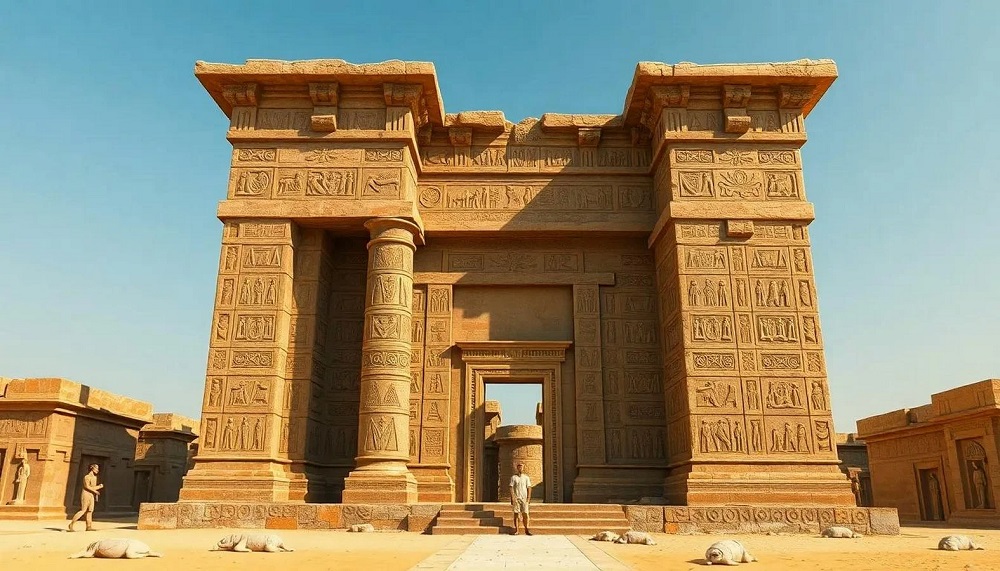
Architecture is often described as history carved into reality. While everyday dwellings reflect the immediate, practical needs of a society, monumental architecture serves a vastly different purpose. These grand structures—built on a scale that deliberately dwarfs the individual—are physical manifestos. They project the values, cosmic beliefs, political ideologies, and cultural identities of the civilizations that erected them.
Across geography and eras, humanity has consistently used stone, mortar, and geometry to communicate with both contemporaries and posterity. By examining these structures, we decode the silent language of the past, uncovering how grand design translates directly into cultural symbolism.
The Confluence of Cosmological and Spiritual Beliefs
For much of human history, the boundary between the earthly and the divine was considered fluid, if not entirely nonexistent. Monumental architecture frequently functioned as an axis mundi—a central pivot connecting heaven and earth. Through precise alignment, specific geometries, and sheer verticality, ancient builders sought to mirror the order of the cosmos.
The Pyramids of Giza: Vessels for Cosmic Ascent
In ancient Egypt, the Pharaoh was not merely a political ruler but a living god, a vital link between humanity and the divine pantheon. The Old Kingdom pyramids, particularly the Great Pyramid of Giza, are absolute reflections of this theological framework.
-
The Shape as a Solar Metaphor: The pyramidal form mimics the benben stone, the primordial mound from Egyptian creation myths. Furthermore, the sloping sides represent the rays of the sun descending through the clouds, providing a physical ramp for the deceased Pharaoh’s soul to ascend into the heavens.
-
Astronomical Alignment: The precision with which the pyramids are aligned to the cardinal points is not an engineering fluke; it reflects the Egyptian obsession with cosmic order (Ma’at). The internal shafts, long thought to be mere air vents, point directly toward the pole stars and Orion, ensuring the king’s spirit would find its rightful place among the imperishable stars.
Gothic Cathedrals: Engineering the Divine Light
Shifting to medieval Europe, the construction of Gothic cathedrals like Notre-Dame de Paris or Chartres Cathedral signaled a massive shift in Christian theology. The previous Romanesque style featured thick, oppressive walls and dark interiors, emphasizing a fortress-like protection against sin. Gothic architecture, conversely, sought to manifest the transcendence and accessibility of God.
-
The Height and Volumetric Freedom: The invention of the pointed arch and the flying buttress allowed architects to build unprecedentedly tall walls with minimal internal supports. This verticality was designed to pull the eyes of the worshiper upward, forcing a physical and spiritual aspiration toward heaven.
-
The Theology of Light: Skeletal stone frameworks allowed for massive expanses of stained glass. This was not merely decorative. Based on the theological writings of Pseudo-Dionysius, light was viewed as the physical manifestation of the divine essence. As sunlight filtered through vibrant glass, it transformed ordinary daylight into lux nova (new light), visually demonstrating the illumination of the human soul by divine grace.
Power, Politics, and Imperial Propaganda
While some monuments look toward the sky, others are firmly rooted in the mechanics of earthly dominance. Emperors, kings, and democratic states alike have long utilized monumental architecture to legitimize power, terrify adversaries, and foster a shared national identity.
The Roman Colosseum: Architecture of Social Control
The Flavian Amphitheater, universally known as the Colosseum, stands as an enduring symbol of imperial Roman engineering and ruthless pragmatism. Commissioned by Emperor Vespasian around 70–72 AD, the structure was a deliberate political maneuver. It was built over the artificial lake of Nero’s widely hated private palace, effectively returning prime urban land to the Roman public.
-
Structured Hierarchy: The very seating arrangement of the Colosseum was a physical manifestation of the Roman class system. The closest seats were reserved for senators, followed by knights, wealthy citizens, and finally, the poor and women at the very top. The architecture reinforced social stratification every time a game was held.
-
The Message of Domination: The bloody spectacles within the arena were calculated displays of state power. By conquering exotic beasts and forcing foreign prisoners of war to fight to the death, Rome visually demonstrated its total dominance over the known world and nature itself to its citizenry.
The Forbidden City: The Spatial Manifestation of the Mandate of Heaven
In Beijing, China, the Forbidden City served as the imperial palace for the Ming and Qing dynasties. The layout of this massive complex is a masterclass in using space to enforce absolute authority.
-
The Central Axis: The palace is organized along a strict north-south axis. The Emperor’s throne sits directly on this line, symbolizing that the ruler is the literal center of the universe, governing under the Mandate of Heaven.
-
Progression and Exclusion: As a visitor moved deeper into the complex, the gates became more restricted and the architectural details more opulent. The massive, empty courtyards preceding the Hall of Supreme Harmony were designed to make visiting officials feel profoundly small and vulnerable before they ever laid eyes on the monarch.
Collective Identity and National Rebirth
As societies transitioned away from absolute monarchies and imperial rule, the symbolic utility of monumental architecture evolved. Modern monuments often celebrate collective memory, honor foundational ideals, or signal a nation’s rebirth after periods of intense trauma.
The Eiffel Tower: From Industrial Skepticism to National Icon
When Gustave Eiffel’s iron tower was unveiled at the 1889 World’s Fair, it was met with fierce hostility from the Parisian artistic elite, who labeled it a tragic eyesore. Yet, it quickly evolved into the defining symbol of French cultural identity.
-
A Monument to Progress: The tower was built to celebrate the centennial of the French Revolution. Rather than using traditional marble or classical columns, it was constructed entirely of puddle iron, showcasing structural engineering. It symbolized a modern, forward-looking France that had thrown off the shackles of the old regime to embrace the industrial future.
-
Democratization of the View: Unlike royal palaces where the best vantage points were restricted to nobility, the Eiffel Tower offered platforms accessible to any citizen who bought a ticket. It democratized the cityscape, shifting the perspective of Paris from a city owned by kings to a city owned by its people.
Chandigarh: The Architectural Blueprint of Post-Colonial India
Following the traumatic partition of India in 1947, the state of Punjab lost its historic capital, Lahore, to Pakistan. Indian Prime Minister Jawaharlal Nehru commissioned the Swiss-French architect Le Corbusier to design a completely new capital city: Chandigarh.
-
Breaking with the Past: Nehru explicitly stated that Chandigarh should be a symbol of the freedom of India, unfettered by the traditions of the past. The brutalist concrete government buildings—such as the Palace of Assembly and the Secretariat—rejected both British colonial architecture and traditional indigenous styles.
-
A Symbol of Modernity and Equality: The raw concrete, geometric grids, and functional zoning symbolized a rational, scientific, and democratic future. It was an architectural declaration that a newly independent nation was fully capable of self-determination and modernization on its own terms.
Conclusion: The Living Text of Civilization
Monumental structures are far more than triumphs of engineering or aesthetic achievements; they are the physical manifestations of human belief systems frozen in time. Whether through the astronomical precision of an Egyptian pyramid, the light-filled heights of a European cathedral, the calculated geometry of an imperial Chinese palace, or the raw industrial optimism of a modern tower, these structures tell us exactly what their creators valued most. By studying these monuments, we do not simply look at old stones; we read the grand, unfolding narrative of human culture itself.
Frequently Asked Questions
Why did ancient civilizations prioritize monumental architecture despite the extreme economic and human costs?
Ancient civilizations viewed these structures as essential investments rather than luxuries. Monumental architecture served as a primary tool for state survival, religious appeasement, and social cohesion. By consolidating wealth and labor into a singular, awe-inspiring project, rulers could legitimize their authority, prove their favor with the gods, and create a shared sense of pride and identity among their subjects, which helped prevent rebellions and internal fracture.
How does the choice of building materials contribute to the symbolism of a monument?
Material selection carries deep cultural meaning. Permanent materials like granite, marble, and limestone were chosen for structures intended to represent eternal concepts, such as the afterlife or the permanent authority of the state. Conversely, materials like brick, wood, or raw concrete can symbolize local resourcefulness, democratic utility, or a deliberate break from historical traditions. The effort required to harvest and transport rare materials over vast distances also served to broadcast a civilization’s immense wealth and logistical capability.
In what ways does architectural symmetry influence the perception of political stability?
Symmetry inherently communicates balance, predictability, and control. When applied to political architecture, such as palace complexes or supreme courts, a perfectly symmetrical facade suggests that the governing body is stable, orderly, and deeply rooted. It creates a psychological sense of security and permanence, implying that the laws and leadership of the nation are as unshakeable and balanced as the building itself.
What is the symbolic distinction between vertical and horizontal monumentality?
Vertical monumentality focuses on height, using towers, spires, and pyramids to draw the eye upward. This typically symbolizes an aspiration toward the divine, spiritual transcendence, or an aggressive assertion of dominant power over the surrounding landscape. Horizontal monumentality, characterized by sprawling complexes, massive plazas, and wide courtyards, symbolizes endurance, total territorial control, and the expansive reach of an empire or institution.
Can a monument’s cultural symbolism completely change over time without altering the physical structure?
Yes, a process known as re-contextualization frequently alters meaning. A structure originally built to celebrate imperial dominance or a hated dictator can be repurposed by subsequent generations into a museum, a public park, or a memorial for the victims of that very regime. The physical building remains identical, but the cultural narrative shifts from a symbol of oppression to a symbol of resilience, education, and collective memory.
How did the transition from religious to secular societies impact the design of monumental architecture?
As societies secularized, the focus of monumental design shifted from honoring the gods to honoring human achievements, civic ideals, and economic progress. Instead of cathedrals and temples dominating city skylines, civic centers, museums, universities, and corporate skyscrapers took prominence. The symbolism transitioned from celestial mysticism and divine fear to humanistic rationality, financial power, and democratic accessibility.